

- Add to your calendar
-
Share on





Rapid and Living Evidence Synthesis for Environmental Action: Best Practices and Next Steps
Rapid evidence synthesis can be defined as “a series of methods that adapts systematic review methods for shorter timelines than for a full systematic review” (ImpSciMethods.org). It can be flexibly delivered in the timeframes required by decision makers, and is policy oriented.
Rapid evidence synthesis has been widely and successfully used in healthcare, notably during the Covid-19 pandemic. Some organisations are also pioneering it for climate, as it can provide practical solutions and approaches based on scientific findings.
Background
The world is facing an increasingly narrow window of opportunity to address the climate crisis and ensure climate resilient development (see https://unfccc.int/documents/650201, 2025). To identify the development pathways, scientific evidence is needed. Rapid and living evidence synthesis approaches offer an opportunity to synthesise and deliver scientific evidence to end users in a faster, more fluid manner. While these methodologies have certain limitations, they can potentially improve science-policy interfaces, facilitate uptake of scientific evidence in practice, and help identify gaps in existing scientific knowledge as well as avenues of future scientific collaboration. As such, they can be useful to research performing and research funding organisations, policy makers, and other end users of scientific knowledge, such as businesses.
The use of rapid and living evidence synthesis is growing across disciplines. These approaches have been especially popular in care and healthcare, however, they are also being used in the fields of education, built environment, crime studies, climate and environmental science, among others.
The capacity to provide scientifically sound analysis on a shorter time scale is arguably all the more important now, when Large Language Models (AI) are being widely used to search for information. AI-powered and scientifically sound evidence synthesis can assist with exploiting the exponentially growing scientific literature more fully.
This webinar forms part of a planned series of three inter-linked workshops building on the Guidance on Science for Policy Activities published by Science Europe in April 2024. Together, the workshops will explore innovative approaches to strengthening the science–policy interface, including how research can be more effectively embedded in policy making, how values-based and independent scientific engagement can be supported, and how institutional cultures, governance models, and emerging issues such as the use of artificial intelligence shape the production, validation, and use of evidence.
Within this broader framework, the present workshop focuses specifically on rapid and living evidence synthesis as a practical tool for improving the timely, credible, and accessible use of scientific knowledge in environmental decision-making. It aims to discuss best practices, identify both opportunities and constraints faced by research funding and performing organisations, and discuss the use of rapid/living evidence with policy-makers.
Aim of the webinar
This webinar builds on an earlier exploratory webinar, which took place in June 2025, addressing the potential use of rapid and living evidence synthesis approaches in environmental research. It will continue the discussion, aiming to identify lessons and ways forward for research organisations.
The first panel will serve to showcase the latest developments in rapid and living evidence synthesis, with a focus on relevant projects and initiatives.
The second panel will discuss the implications for research funding and performing organisations, as well as policy-makers.
Organisers
This webinar was co-organised by the Foundation for Science and Technology (FCT), German Committee Future Earth (DKN), Health Research Board (HRB) of Ireland, Hungarian Research Network (HUN-REN), Potsdam Institute for Climate Impacts Research (PIK), UK Research and Innovation (UKRI), University of Cambridge, and Science Europe.

Guiding Questions for the Webinar
- What are the latest advances when it comes to rapid and living evidence synthesis?
- How can we harness the potential of AI, and the rich and diverse sources of environmental information to inform decision-making by policymakers?
- How can we integrate environmental information with other types of research evidence to support policy decision making around both environmental challenges, and challenges in other domains?
- How can we build capacity and capability amongst producers and users of environmental evidence syntheses?
- What are the next possible steps for decision makers, research organisations and other stakeholders?
Programme
14.00-14.10 Welcome and Introduction
- Dr. Diana Potjomkina, Senior Policy Officer, Greening Research, Science Europe
14.10:14.40 Presentations: Latest Advances in Rapid and Living Evidence Synthesis
- Declan Devane, Director, Evidence Synthesis Ireland & Cochrane Ireland, and Professor of Health Research Methodology, University of Galway
- Dr. Steven J. Cooke, Professor and Director, Canadian Centre for Evidence-Informed Conservation, Carleton University Biljana Macura, Senior Research Fellow, Stockholm Environment Institute and Collaboration for Environmental Evidence; Editor in Chief, Environmental Evidence
- Sarah Miller, Queen’s University Belfast, Principal Investigator of the METIUS project
Moderator: Dr. Jan C. Minx, Head of the Evidence for Climate Solutions Working Group at the Potsdam Institute for Climate Impact Research
14.40-15.30 Panel Discussion
Rapid and Living Evidence Synthesis: Lessons and Ways Forward for Research Funding and Performing Organisations and Policy-Makers
- Dr. Daniela Jacob, Director of Climate Service Centre Germany (GERICS) and Honorary Professor at the School of Sustainability, LEUPHANA University Lüneburg
- Dr. Koen Jonkers, Head of Unit, JRC Centre for Advanced Studies and Chair of the JRC Scientific Committee
- Dr. Rupert Lewis, Deputy Executive Chair, Natural Environment Research Council
Moderator: Dr. Eldrid Herrington, Honorary Fellow, University of Cambridge Judge Business School
15.30-15.50 Q&A Session
15.50-16.00 Closing Remarks
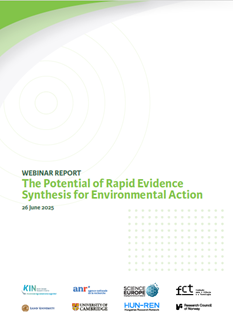
Report on Exploratory Webinar on the Potential of Rapid Evidence Synthesis for Environmental Action
This report summarises the outcomes of the webinar on 'The Potential of Rapid Evidence Synthesis for Environmental Action.' It highlights key discussions on how rapid and living approaches to synthesising scientific evidence can accelerate environmental action and support evidence-based policymaking.