21
Nov.
2018
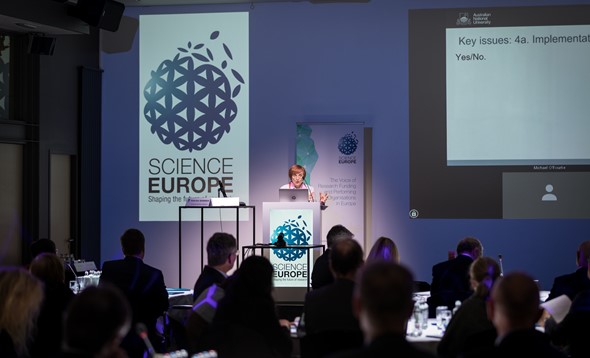
Science Europe Symposium 2018
The 2018 Science Europe Symposium took place in Brussels, Belgium. The topic was 'Interdisciplinarity'.
Member-only content is available on this page. Please log in to view this content.
60 item(s) found
Science Europe calls on research funding and performing organisations to continuously evaluate their research assessment processes to ensure that they are effective, efficient, fair, and transparent.

In 2019, Science Europe conducted a flagship study on research assessment processes and practices. The study was developed and overseen by the Science Europe Task Force on Research Assessment and the Science Europe Office, and implemented by Technopolis Group Vienna.

Interdisciplinarity is increasingly used to tackle complex scientific questions and address large societal challenges. At the same time, the evaluation of interdisciplinary research proposals poses a set of problems, ranging from missing common standards and criteria to shortages of peer reviewers with experience in evaluating interdisciplinary research. At its third Symposium, Science Europe and its Scientific Advisory Committee brought together researchers and other experts experienced in interdisciplinarity with high-level representatives from Science Europe’s Member Organisations, who fund and perform such research.

Released in partnership with the European University Association (EUA), this joint statement demonstrates a commitment to building a strong dialogue between members of both associations, who share the responsibility of developing and implementing more accurate, open, transparent, and responsible approaches that better reflects the evolution of research activity in the digital era.
The 2018 Science Europe Symposium took place in Brussels, Belgium. The topic was 'Interdisciplinarity'.

Fundamental science and curiosity-driven research are key drivers of change for their intrinsic value and long-term unexpected impact. However, many other aspects are also important such as challenge oriented research and co-creation of knowledge. This report captures key discussions from Science Europe’s first Symposium on impact and includes four case studies illustrating the unexpected impact of research on subjects ranging from privacy to nano-encapsulation.

Science Europe advocates using the notion of ‘value’ of research. This is wider than ‘impact’ and reflects the intrinsic value of scientific research and its capacity to generate new knowledge. This statement provides a series of key principles and actions for policy makers and research organisations to help bring forward a new vision of impact assessment.

The 2016 Symposium of Science Europe took place in Brussels, Belgium. The topic was 'Building a Narrative on Impact and the Societal Value of Science'.

A major challenge in striving for energy efficiency is the selection of technological systems, particularly given the need to consider multiple environmental, economic and social concerns. In addition, the general public, policy makers and experts alike misunderstand the physical nature of energy and hence its efficient use. After decades of fragmented agreements, regulations, treaties, strategies, indicators, targets, directives and communications, the European Union (EU) in its Energy Union strategy needs to take the lead in restoring the energy debate to firm foundations: those of thermodynamics, the science of energy.

The Roadmap, approved by the Science Europe General Assembly in November 2013, is Science Europe’s action plan to contribute to the elements of a successful research system. It acts as a framework for voluntary collective activity, providing a long-term strategy for the association. The ‘Priority Action Areas’ are those in which Science Europe members believe that there is a potential to achieve tangible and substantive progress, and where they can add real value by working together.