
Member-only content is available on this page. Please log in to view this content.

Our resources
Discover Science Europe’s comprehensive library of resources, including the most recent publications, briefings, and position statements.
58 resource(s) found
25.06.2019
Science Europe Symposium on Interdisciplinarity
Interdisciplinarity is increasingly used to tackle complex scientific questions and address large societal challenges. At the same time, the evaluation of interdisciplinary research proposals poses a set of problems, ranging from missing common standards and criteria to shortages of peer reviewers with experience in evaluating interdisciplinary research. At its third Symposium, Science Europe and its Scientific Advisory Committee brought together researchers and other experts experienced in interdisciplinarity with high-level representatives from Science Europe’s Member Organisations, who fund and perform such research.
-
Share on
- Download




14.05.2019
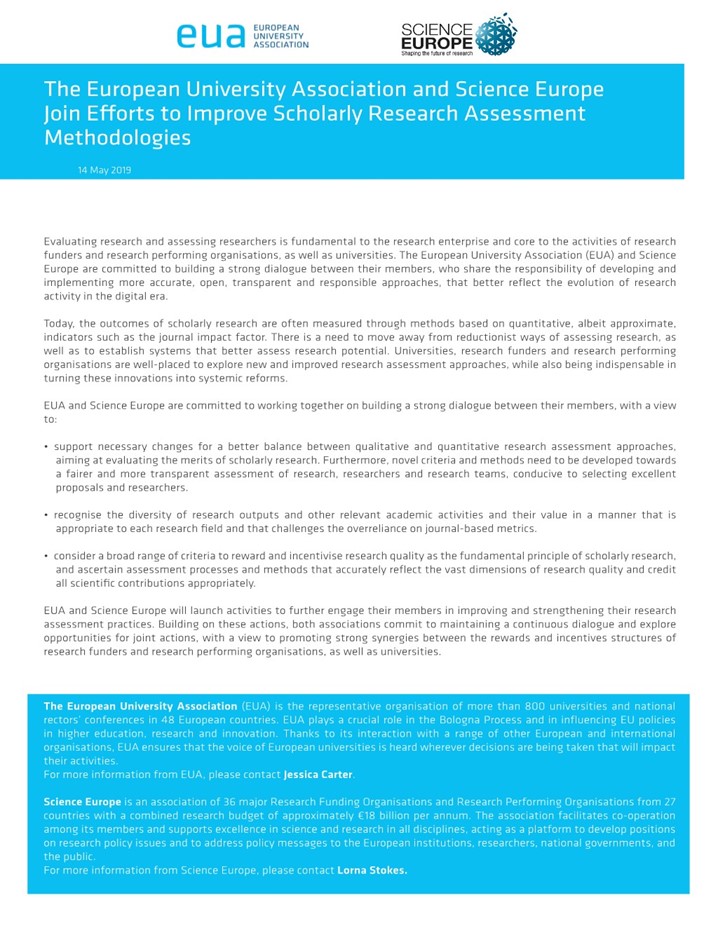
Joint Statement on Research Assessment
Released in partnership with the European University Association (EUA), this joint statement demonstrates a commitment to building a strong dialogue between members of both associations, who share the responsibility of developing and implementing more accurate, open, transparent, and responsible approaches that better reflects the evolution of research activity in the digital era.
-
Share on
- Download
04.09.2017
Cross-border Collaboration and Portfolio Management of Research Infrastructures
This report explores the challenges facing research funding and performing organisations to design and manage balanced Research Infrastructure (RI) portfolios and design effective cross-border collaborations when setting up and running joint RIs. Discussions with a broad range of stakeholders took place at a dedicated workshop co-hosted by Science Foundation Ireland and the Health Research Board.
-
Share on
- Download
11.07.2017
Position Statement on a New Vision for More Meaningful Research Impact Assessment
Science Europe advocates using the notion of ‘value’ of research. This is wider than ‘impact’ and reflects the intrinsic value of scientific research and its capacity to generate new knowledge. This statement provides a series of key principles and actions for policy makers and research organisations to help bring forward a new vision of impact assessment.
-
Share on
- Download
03.10.2015
Lead Agency Procedure Strategies
This report analyses the underlying preconditions and efficiency of Lead Agency Procedure (LAP), based on the evidence available from the many LAP partnerships among Science Europe’s members. It also contains policy recommendations for research organisations so that they gain a more accurate understanding of the Lead Agency principles and are made more able to judge on its scope and limitations.
-
Share on
- Download
15.12.2014
The Importance of International Collaboration for Fostering Frontier Research
In this paper produced by the Scientific Committee for the Life, Environmental and Geo Sciences, the Committee argues that in order to strengthen international collaborative research, the national research funding organisations should consider increasing their efforts to widen the participation of various European countries and global partners in multilateral schemes, whilst fostering interdisciplinarity and knowledge integration. Moreover, a bottom-up approach should be adopted in order to collect research proposals that contain novel ideas and solutions, captured directly from the research community and users, thus enabling open innovation.
-
Share on
- Download
01.01.2014
Practical Guide to Three Approaches to Cross-border Collaboration
In a globalised research ecosystem, collaboration is key. This collaboration also brings challenges linked to the diversity of scientific and legal environments. The aim of this practical guide is to provide better and more efficient means for research organisations to apply a set of optional models for cross-border collaboration and to help them achieve more successful and easier implementation.
-
Share on
- Download
02.12.2013
Science Europe Roadmap
The Roadmap, approved by the Science Europe General Assembly in November 2013, is Science Europe’s action plan to contribute to the elements of a successful research system. It acts as a framework for voluntary collective activity, providing a long-term strategy for the association. The ‘Priority Action Areas’ are those in which Science Europe members believe that there is a potential to achieve tangible and substantive progress, and where they can add real value by working together.
-
Share on
- Download