
Member-only content is available on this page. Please log in to view this content.

Our resources
Discover Science Europe’s comprehensive library of resources, including the most recent publications, briefings, and position statements.
5 resource(s) found
23.01.2026
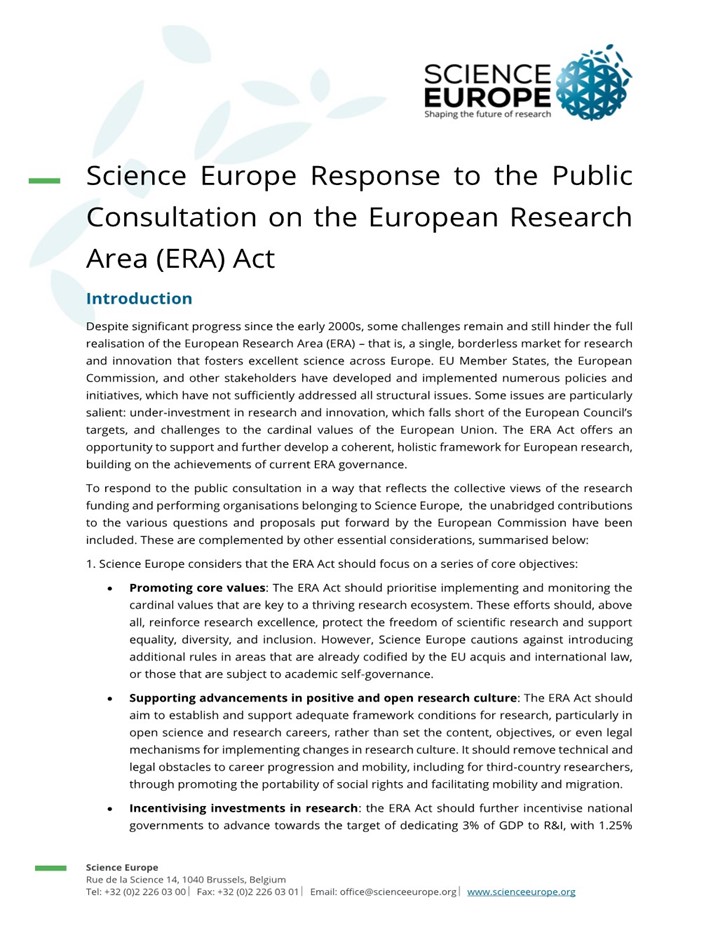
Science Europe Response to the Public Consultation on the ERA Act
Science Europe has responded to the European Commission’s public consultation on the proposed European Research Area (ERA) Act, setting out the collective views of its Member Organisations on how the legislation can effectively strengthen framework conditions for research and innovation, while safeguarding academic freedom, institutional autonomy, and the diversity of national research systems.
-
Share on
- Download




15.07.2025
2024 Annual Report: Advancing Excellence, Realising Impact
Science Europe made excellent progress on its research policy priorities in 2024, delivering key outputs in various areas, including science communication, research assessment, open science, the sustainability of research, international collaboration, and equality, diversity, and inclusion.
-
Share on
- Download
17.12.2020
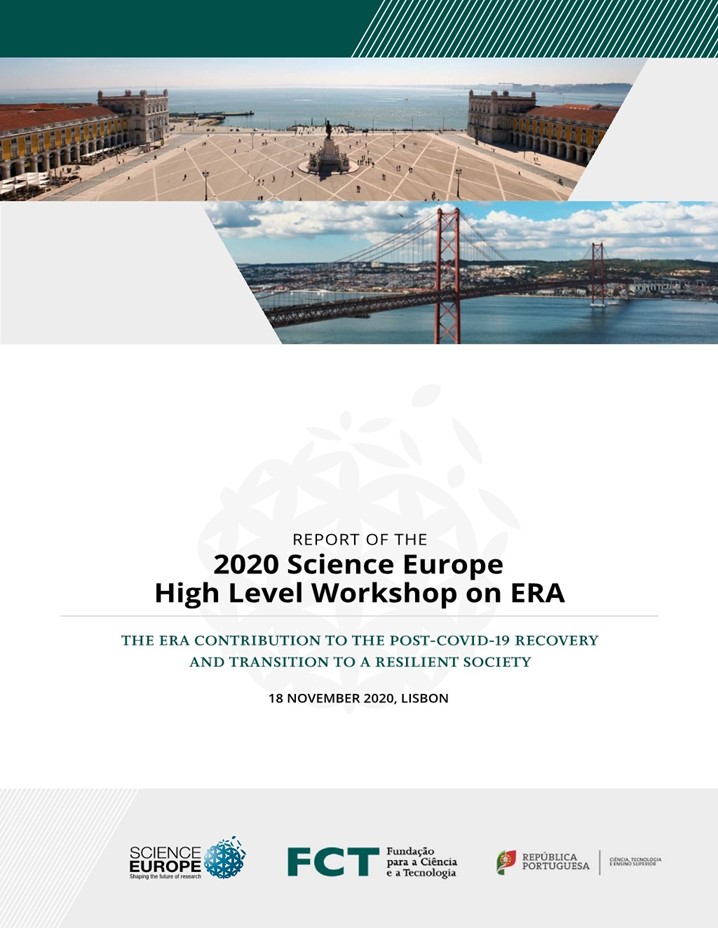
Report of the 2020 High Level Workshop on ERA: The ERA Contribution to the post-COVID-19 Recovery and Transition to a Resilient Society
The 2020 edition of the Science Europe High Level Workshop on ERA was co-hosted with the Foundation for Science and Technology and the Portuguese Ministry of Science, Technology, and Higher Education. It explored how research and innovation can contribute to crisis recovery and to societal resilience in the context of an evolving research culture.
-
Share on
- Download
23.06.2016
Career Pathways in Multidisciplinary Research: How to Assess the Contributions of Individual Members of Large Teams
Scientific research increasingly relies on large collaborative, multi-disciplinary, and interdisciplinary research teams – often working across borders and across sectors – to address big societal questions. This report considers how research organisations can best support collaborative, multi-disciplinary, and interdisciplinary research teams. It also considers how can they allocate appropriate credit for research input and better evaluate multidisciplinary research.
-
Share on
- Download
16.01.2016
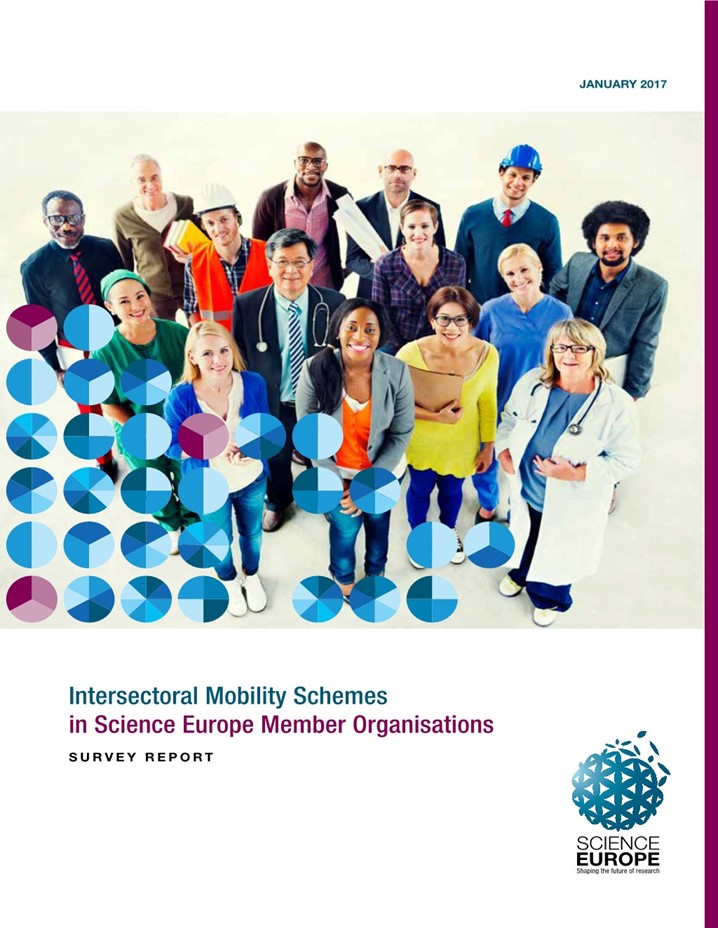
Intersectoral Mobility Schemes in Science Europe Member Organisations
Intersectoral mobility of researchers is gaining political momentum in Europe, with more interest in bringing in the competences that characterise researchers into public, private, and not-for-profit sectors. This survey report looks at the diversity of measures that are in place within Science Europe Member Organisations to enable researchers to be more mobile across different sectors of employment
-
Share on
- Download
MORE?