Science Europe Symposium 2017
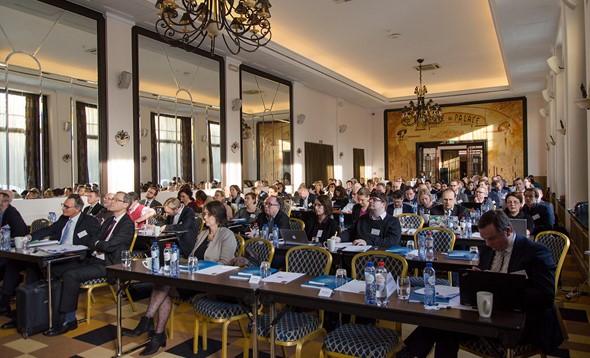
The 2017 Science Europe Symposium took place in Brussels, Belgium. The topic was 'Science Without Borders'.
Member-only content is available on this page. Please log in to view this content.
203 item(s) found
Research organisations and funders increasingly ask researchers to create Data Management Plans for their work and proposals. A lack of standardisation means that these can be time-consuming to create and difficult to compare and evaluate. Science Europe presents a framework for the creation of domain-specific protocols that can be used as standardised templates, reducing the administrative burden on both researchers, research organisations, and funders.
Science Europe supports the principle that research data should be “as open as possible and as closed as necessary.” However, the particularity of research data as well as of data about research activities requires careful consideration on which aspects are better dealt with by legislative acts or by guidelines developed by the research sector.
The 2017 Science Europe Symposium took place in Brussels, Belgium. The topic was 'Science Without Borders'.
Science Europe welcomes the efforts made towards the European Open Science Cloud (EOSC). In this open letter, the Governing Board of Science Europe reinforces its view that research data should be permanently, publicly, and freely available for re-use. The proposed EOSC aims to further this goal but a number of important questions still remain.
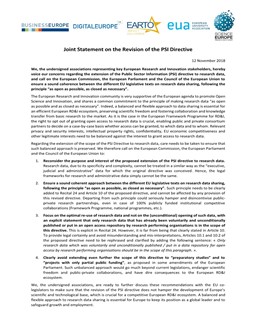
This open letter, signed by the European Research and Innovation community, calls on Members of the European Parliament and the Council to secure Europe’s leadership in the data economy by revising the Text and Data Mining (TDM) exception in the draft of the Directive on Copyright in the Digital Single Market. It calls for the TDM exception to apply to any person that has legal access to the content to help the European data economy grow, foster innovation, and encourage entrepreneurship.
This open letter issued by the international research community calls on Members of the European Parliament to halt the adoption of harmful provisions found in the current draft of the Directive on Copyright in the Digital Single Market, which could threaten Open Access and Open Science.
This report explores the challenges facing research funding and performing organisations to design and manage balanced Research Infrastructure (RI) portfolios and design effective cross-border collaborations when setting up and running joint RIs. Discussions with a broad range of stakeholders took place at a dedicated workshop co-hosted by Science Foundation Ireland and the Health Research Board.
Science Europe is committed to playing a role in accomplishing the transition to Open Access in an efficient and sustainable way and encourages scientific institutions to disclose payments of Open Access publication fees by participating in the ‘Open APC Initiative.’ This paper highlights how this will help create a more transparent cost structure in the Open Access publication market and stimulate competition.
CESAER, EUA, LERU, and Science Europe release this joint statement calling on European policy makers to provide new momentum for the European Research Area (ERA). The ERA is a treaty obligation of the European Union and today, more than ever, greater commitment to research is needed to tackle the challenges that Europe faces. By strengthening the ERA, and increasing funding for research, European policy makers would be giving Europe the resources it needs to embark on another 60 years of peace and prosperity.
Research organisations have a crucially important role to play in addressing gender inequality; not only for the benefit of their own ecosystem, but to contribute to progress in wider society. This practical guide sets out good practice examples and guides the further development of context specific approaches including how to avoid unconscious bias in peer review processes, how to monitor gender equality, and how to improve grant management practises.
This document complements the ‘Practical Guide to Improving Gender Equality in Research Organisations.’ It provides the qualitative and quantitative background data on which parts of the guide are based and measures the implementation of gender equality measures within Science Europe Member Organisations.
Open Access greatly improves the pace, efficiency, and efficacy of research. This report highlights the efforts made by public research organisations in Europe to develop and implement Open Access policies and addresses the challenges faced by different actors in order to facilitate and accelerate the transition towards full Open Access for all scholarly publications by 2020.
The recent legislative proposal from the European Commission to reform EU copyright law addresses some needs, but not to the full extent required. Science Europe calls for research and data mining exceptions to ensure that copyright legislation is friendly to research and innovation.
Text and data mining (TDM) is hugely important for science as it can facilitate better research and the free flow of knowledge across borders. This report urges policy-makers to update the legal framework in the context of the upcoming EU copyright reform in order to allow TDM for commercial and non-commercial means, and also to clarify the legal position surrounding it.
Decisive action is needed to transition towards more effectively and efficiently towards an Open Access publishing system. This paper presents some of the recent trends and developments in the transition to Open Access, as well as various business models currently in use which aim to facilitate this transition. It also highlights expected benefits and underlines remaining challenges.
This report analyses the underlying preconditions and efficiency of Lead Agency Procedure (LAP), based on the evidence available from the many LAP partnerships among Science Europe’s members. It also contains policy recommendations for research organisations so that they gain a more accurate understanding of the Lead Agency principles and are made more able to judge on its scope and limitations.
This position statement highlights the added value of Joint Programming Initiatives (JPIs) as perceived by Science Europe Member Organisations, and makes two recommendations on the future of joint programming: one with regards to the evaluation of JPIs, and a second one concerning their governance. The aim is to stimulate other stakeholders – including the European Commission – to join in this discussion.
This publication by Science Europe’s Scientific Committee for the Social Sciences addresses two audiences: scientists, especially those who have been traditionally more resistant to the OA approach, and policy makers. In it, the Scientific Committee for Social Sciences proposes a ‘Diamond Engagement’ concept with the three key principles: partnership; standardisation and interoperability; and enabling structures.
Open Access, as defined in the Berlin Declaration, means unrestricted, online access to peer-reviewed, scholarly research papers for reading and productive re-use, not impeded by any financial, organisational, legal or technical barriers. Ideally, the only restriction on use is an obligation to attribute the work to the author. Science Europe Member Organisation are committed to a shared set of principles on Open Access to ensure consistency and coherence in their efforts and activities.
Text and Data Mining (TDM) helps the analysis and extraction of new insights and knowledge from vast amount of digitally-available content. It offers great potential for research, but also for the economy and society as a whole since it enables innovation. This paper gives an overview of some of the legal hurdles faced by researchers using TDM practices, flags possible action lines for research organisations, and calls for a more science-friendly EU copyright law.
In this paper produced by the Scientific Committee for the Life, Environmental and Geo Sciences, the Committee argues that in order to strengthen international collaborative research, the national research funding organisations should consider increasing their efforts to widen the participation of various European countries and global partners in multilateral schemes, whilst fostering interdisciplinarity and knowledge integration. Moreover, a bottom-up approach should be adopted in order to collect research proposals that contain novel ideas and solutions, captured directly from the research community and users, thus enabling open innovation.
The 2012 Communication ‘A Reinforced European Research Area Partnership for Excellence and Growth’ laid out the current approach for realising a European Research Area (ERA). As this approach is now being reviewed by the European institutions, Science Europe puts forward its analysis of Priority One of the Communication, in order to start a fruitful dialogue with the European institutions on the future of ERA policy. This analysis provides a practical example as to why the current ERA Communication approach needs to be thoroughly reviewed if ERA policy is to have a real impact.
In a globalised research ecosystem, collaboration is key. This collaboration also brings challenges linked to the diversity of scientific and legal environments. The aim of this practical guide is to provide better and more efficient means for research organisations to apply a set of optional models for cross-border collaboration and to help them achieve more successful and easier implementation.