

Diamond Open Access Conference
Science Europe, OPERAS, cOAlition S, and ANR organised a first conference on Diamond Open Access to discuss operationalisation of the Action Plan for Diamond Open Access and to introduce the DIAMAS project.
Member-only content is available on this page. Please log in to view this content.
89 item(s) found
Science Europe, OPERAS, cOAlition S, and ANR organised a first conference on Diamond Open Access to discuss operationalisation of the Action Plan for Diamond Open Access and to introduce the DIAMAS project.
Science Europe together with cOAlition S, OPERAS, and the French National Research Agency (ANR) organised the Diamond Open Access Conference on 19 and 20 September 2022 in Zadar on the beautiful Croatian coast and online. The event was sponsored by the French Ministry for Higher Education and Research (MESR) and kindly hosted by the University of Zadar.
Science Europe and cOAlition S are pleased to announce the publication of an in-depth report and recommendations arising from a study of community-driven Open Access journals across the world that are free for readers and authors, usually referred to as 'OA diamond journals'.
This open letter issued by the international research community calls on Members of the European Parliament to halt the adoption of harmful provisions found in the current draft of the Directive on Copyright in the Digital Single Market, which could threaten Open Access and Open Science.
FAIRsFAIR has released additional guidance on making Data Management Plans FAIR, based on the January 2021 Science Europe DMP guidance.
Together with OA2020, the Association of African Universities (AAU), cOAlition S, Electronic Information for Libraries (EIFL), the International Science Council (ISC), and UNESCO, Science Europe organised a workshop on ‘Global Equity in Open Access Publishing’.
2023 proved to be another landmark year for Science Europe: building on the achievements of the previous year and setting the direction for new approaches in vital areas of research policy.
The Global Summit on Diamond Open Access in Toluca, México brought together the community for Diamond Open Access to discuss the equity, quality, usability, and sustainability of this scholarly publishing model.
Following the success of the ‘Global Summit on Diamond Open Access’, that took place on 23-27 October in Toluca, Mexico, a concluding statement has now been ratified and released outlining the collective way forward for Diamond Open Access.
Research organisations and funders increasingly ask researchers to create Data Management Plans for their work and proposals. A lack of standardisation means that these can be time-consuming to create and difficult to compare and evaluate. Science Europe presents a framework for the creation of domain-specific protocols that can be used as standardised templates, reducing the administrative burden on both researchers, research organisations, and funders.
Does your organisation want to develop requirements for data management plans (DMPs) or update existing ones?
Take a look at our latest publication to find out how to do so in three steps.
Released in partnership with CESAER and the European University Association (EUA) this joint statement outlines how all publishers must fully respect researchers’ rights by providing clarity and transparency on Open Access.
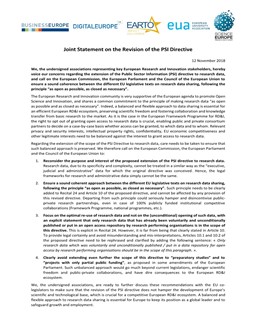
In this joint statement research and Innovation stakeholders call on the EU institutions to seek a balanced approach to data sharing in response to the European Commission’s proposal for a revision of the Directive on re-use of public sector information (PSI Directive). While the partners are supportive of the European agenda to promote Open Science and innovation, and share a common commitment to the principle of making research data ‘as open as possible and as closed as necessary’, there is a need to focus on the optimal re-use of research data and not on the (unconditional) opening of such data.
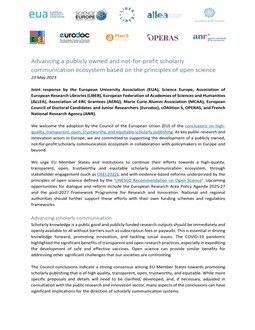
We welcome the adoption by the Council of the European Union (EU) of the conclusions on high-quality, transparent, open, trustworthy, and equitable scholarly publishing. As key public research and innovation actors in Europe, we are committed to supporting the development of a publicly owned, not-for-profit scholarly communication ecosystem in collaboration with policymakers in Europe and beyond.
Science Europe welcomes the launch or renewal of national open science strategies in several European countries.
Science Europe launched the report of its membership survey on the role of research funding and performing organisations in advancing open science and its links to research assessment. It reveals their strategic approaches and activities to evaluate, monitor, and collect evidence on research.
This Multi-annual Action Plan proposes a series of framework actions to guide the implementation of the Science Europe Strategy Plan 2021–2026 in line with the association's updated vision, mission, values, and strategic priorities. The Action Plan was updated in June 2024.
The Science Europe General Assembly adopted the creation of a new working group on Open Science (WG OS) to develop a comprehensive approach towards the topic. WG OS will provide a platform to bring together the Open Science aspects embedded in all activities of Science Europe. It will also broaden the scope of our work in the area, to fulfill the objectives described in the new Science Europe Strategy and Multi-annual Action Plan.
On the occasion of the International Open Access Week 2022 (OA Week 2022) from 24 - 30 October Science Europe reaffirms Open Science as a cross-cutting priority and puts a spotlight on the many activities, initiatives and events carried out in the past months.
Science Europe and its members support Open Science as part of a well-functioning research system. This paper sets the direction for an open and seamless collaboration between research actors and involvement of societal parties where relevant.
It is the opinion of European public R&I actors that publicly funded research and its results should be immediately and openly available to all, without barriers. This is essential to drive knowledge forward, promote innovation, and tackle social issues.
This publication by Science Europe’s Scientific Committee for the Social Sciences addresses two audiences: scientists, especially those who have been traditionally more resistant to the OA approach, and policy makers. In it, the Scientific Committee for Social Sciences proposes a ‘Diamond Engagement’ concept with the three key principles: partnership; standardisation and interoperability; and enabling structures.
This Practical Guide provides guidance to ensure the long-term preservation and accessibility of research data. Three complementary maturity matrices provide funders, performers, and data infrastructures with a way to create a common understanding of the approaches needed.
Developed by experts from Science Europe Member Organisations, this guide aims to align research data management (RDM) requirements across research organisations. Originally released in 2019, it was updated in January 2021 to include guidance to support the evaluation of data management plans (DMPs).