30.06.2021
Science Europe Publications Now on Zenodo
We are pleased to announce that Science Europe is now issuing Digital Object Identifiers (DOIs) for its publications and depositing its publications on the Zenodo platform.

Member-only content is available on this page. Please log in to view this content.
95 item(s) found
We are pleased to announce that Science Europe is now issuing Digital Object Identifiers (DOIs) for its publications and depositing its publications on the Zenodo platform.

The Roadmap, approved by the Science Europe General Assembly in November 2013, is Science Europe’s action plan to contribute to the elements of a successful research system. It acts as a framework for voluntary collective activity, providing a long-term strategy for the association. The ‘Priority Action Areas’ are those in which Science Europe members believe that there is a potential to achieve tangible and substantive progress, and where they can add real value by working together.

Science Europe is pleased to announce that it is signing the San Francisco Declaration on Research Assessment (DORA).

The Science Europe Strategy Plan comes at a crucial time for European Research an Innovation (R&I) and includes an updated vision, mission, values, and set of strategic priorities for the association. It supports its Member Organisation in their mission to create world-class scientific knowledge, delivering more benefit for our societies.

The 2017 Science Europe Symposium took place in Brussels, Belgium. The topic was 'Science Without Borders'.

Science Europe welcomes the efforts made towards the European Open Science Cloud (EOSC). In this open letter, the Governing Board of Science Europe reinforces its view that research data should be permanently, publicly, and freely available for re-use. The proposed EOSC aims to further this goal but a number of important questions still remain.
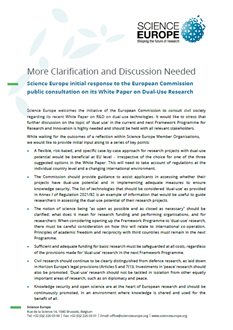
This initial position by Science Europe on ‘Dual-Use’ Research, was submitted on 30 April as a response to the European Commission Consultation on the White Paper on ‘Options for enhancing support for research and development involving technologies with dual-use potential’, following a preliminary discussion with our Governing Board and prior to a broader discussion with our Member Organisations in the context of our upcoming General Assembly Meeting.
This scoping review examines the contributions and unintended consequences of open science in realising results that align with key research culture values such as equity, openness, integrity, care, collaboration, and autonomy.
Commissioned by Science Europe, this review is the result of a collaboration between CWTS and the Know Center.

This open letter, signed by the European Research and Innovation community, calls on Members of the European Parliament and the Council to secure Europe’s leadership in the data economy by revising the Text and Data Mining (TDM) exception in the draft of the Directive on Copyright in the Digital Single Market. It calls for the TDM exception to apply to any person that has legal access to the content to help the European data economy grow, foster innovation, and encourage entrepreneurship.
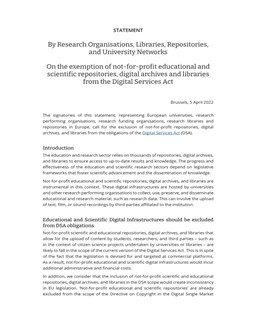
Research organisations, libraries, repositories, and university networks call for the the exclusion of not-for-profit repositories, digital archives, and libraries from the obligations of the Digital Services Act.
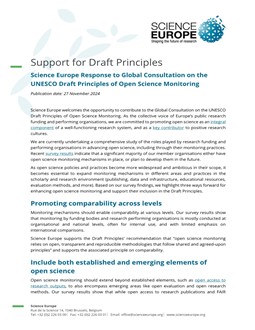
Science Europe responds to the global consultation on the UNESCO Draft Principles on Open Science Monitoring. The principles are a step in the right direction, aligning with the priorities and practices of Science Europe's Member Organisations.
This report analyses the role of public research funding and performing organisations in Europe in the shifting landscape of open science and research assessment reform. The findings demonstrate how Science Europe's Member Organisations actively shape and contribute to these developments.

Science Europe launches an invitation to tender for comprehensive desk research into strategic approaches to, and research assessment of, open science. The tender is open until 6 February 2025.
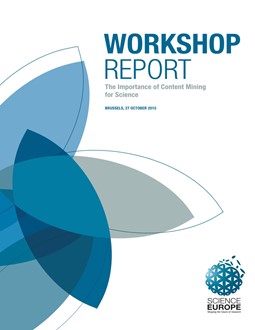
Text and data mining (TDM) is hugely important for science as it can facilitate better research and the free flow of knowledge across borders. This report urges policy-makers to update the legal framework in the context of the upcoming EU copyright reform in order to allow TDM for commercial and non-commercial means, and also to clarify the legal position surrounding it.
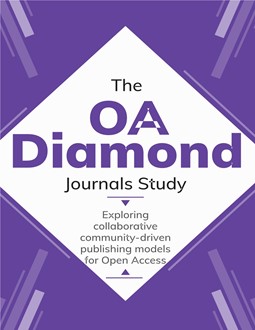
Science Europe and cOAlition S publish an in-depth report and recommendations arising from a study of community-driven Open Access journals across the world that are free for readers and authors, usually referred to as 'OA diamond journals'.

How can citizens best be involved in the scientific process, and how ‘Open’ can we make science? How do we ensure that the highest standards in scientific research are maintained in such a system? This report provides an overview of the main discussions at the 2017 Science Europe High-level Workshop hosted in Berlin by the German Research Foundation (DFG).
This webinar explored the latest initiatives in monitoring and evidence gathering for open science and research assessment reform, and marked the launch of our new scoping review.
Science Europe, cOAlition S, OPERAS, and ANR organise a webinar on 22 April for the endorsers of the Action Plan for Diamond Open Access to gather their views on the next steps.

The interoperability and sustainability of research data are an indispensable element of the shift towards an Open Science system. At this event, Science Europe presented strategic guidance for research performers, funders, and data infrastructures to help ensure long-term preservation and accessibility of research data.