




Member-only content is available on this page. Please log in to view this content.
17.06.2016
- Download
-
Share on
In a Resource-constrained World: Think Exergy, not Energy
When we think about energy, we consider it in terms of quantity. However, in a resource-constrained world, energy and in particular its efficiency, must also be appreciated from the point of view of quality, which is its ability to do work. In order to include the quality and not just the quantity of energy, we need to measure ‘exergy’. This brochure introduces the concept of exergy and provides examples of its application.
Download resourceRelated content
16.10.2026
Science Europe Responds to European Commission consultation on European Partnerships
Science Europe has responded to the European Commission’s consultation on European Partnerships under the next EU Research and Innovation Framework Programme (2028–2034), building on its June 2026 Position Statement.
-
Share on
- Download
15.10.2026
Science Europe Response to the European Commission Consultation on the Evaluation of the Dual-Use Regulation
Science Europe has responded to the European Commission’s consultation on the evaluation of the EU Dual-Use Regulation, highlighting the need for a proportionate approach that addresses research security risks while safeguarding responsible international research collaboration.
-
Share on
- Download
07.10.2026
Guidance Document on Science Communication and Research Culture
This guidance document provides a practical framework to help research organisations strengthen and embed science communication in research cultures and across the research lifecycle.It includes principles for responsible and effective science communication, and a tool to help organisations review their approaches.
-
Share on
- Download
28.09.2026
Webinar Report: Rapid and Living Evidence Synthesis for Environmental Action: Best Practices and Next Steps
The report from the Science Europe webinar Rapid and Living Evidence Synthesis for Environmental Action: Best Practices and Next Steps, held on 27 April 2026, explores evolving approaches to evidence synthesis and their role in connecting research evidence with timely, science-informed environmental decision making. It highlights the potential of rapid and living evidence synthesis, as well as the opportunities and challenges of using artificial intelligence in the process.
-
Share on
- Download
16.09.2026
Science Europe Response to the EU Consultation on Do No Significant Harm in the 2028-34 EU Multiannual Financial Framework
Science Europe has responded to the European Commission consultation on the application of the ‘Do No Significant Harm’ (DNSH) principle under the 2028–2034 Multiannual Financial Framework, calling for an approach that supports environmental sustainability while recognising the specific characteristics of research and innovation.
-
Share on
- Download
03.09.2026
Strengthening Academic Freedom & Institutional Resilience in the European Research Area
This report explores the evolving challenges facing academic freedom and highlights the role of institutional autonomy, sustainable funding, research integrity, and supportive research environments in safeguarding it. It also identifies priorities for strengthening academic freedom across the European Research Area.
-
Share on
- Download
27.08.2026
NRFU-SE Webinar Series: Transforming Research Assessment Systems: Criteria, Quality, and Societal Impact
This report summarises the discussions from the fourth webinar in the NRFU–Science Europe Webinar Series 'Building Capacity in the Ukrainian Research and Innovation Ecosystem,' exploring ongoing developments in responsible research assessment and examining how evolving approaches to assessment can contribute to improving research quality, fostering positive research cultures, and recognising a broader range of research contributions and impacts.
-
Share on
- Download
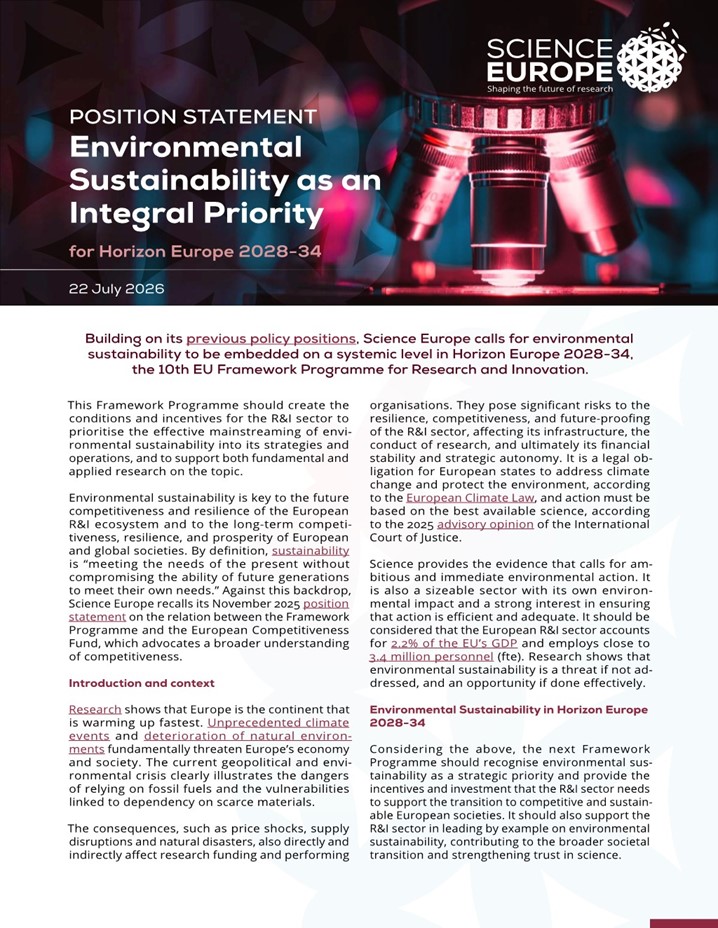
22.07.2026
Environmental Sustainability as an Integral Priority for Horizon Europe 2028–34
By including environmental sustainability into the next Horizon Europe Framework Programme as an integral priority, the programme can help strengthen the resilience, efficiency, and competitiveness of European R&I systems.
-
Share on
- Download
16.07.2026
2025 Annual Report: Delivering Excellence in a Changing World
This Annual Report provides an overview of the progress and achievements of Science Europe across the research policy topics that it worked on in 2025, including FP10 development, research culture, trust in science, research security, Artificial Intelligence, research assessment, environmental sustainability, inclusion, and open access.
-
Share on
- Download
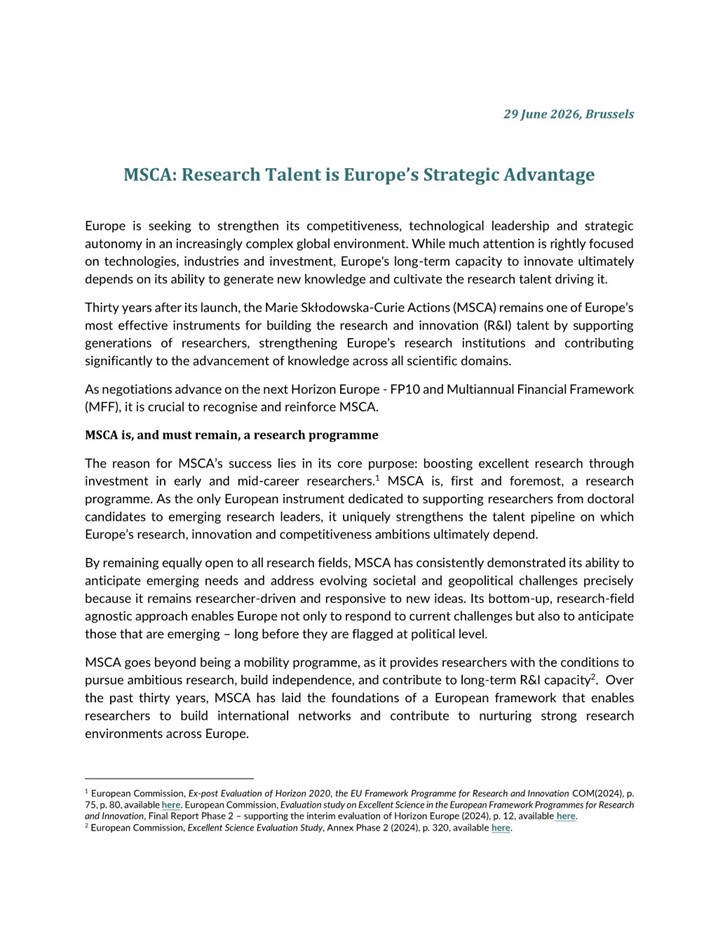
29.06.2026
Joint statement: MSCA: Research Talent is Europe's Strategic Advantage.
Science Europe has joined a coalition of European research and innovation organisations in publishing a joint statement MSCA: Research Talent is Europe's Strategic Advantage.
-
Share on
- Download
MORE?